The 1st Age
As the distinct lineages settled into their chosen environments, the era of survival gave way to the Age of Nations. The Great Northern Continent was transformed by the industry, magic, and ambition of its inhabitants.
The Elven Dominion: The Sylvan Weave
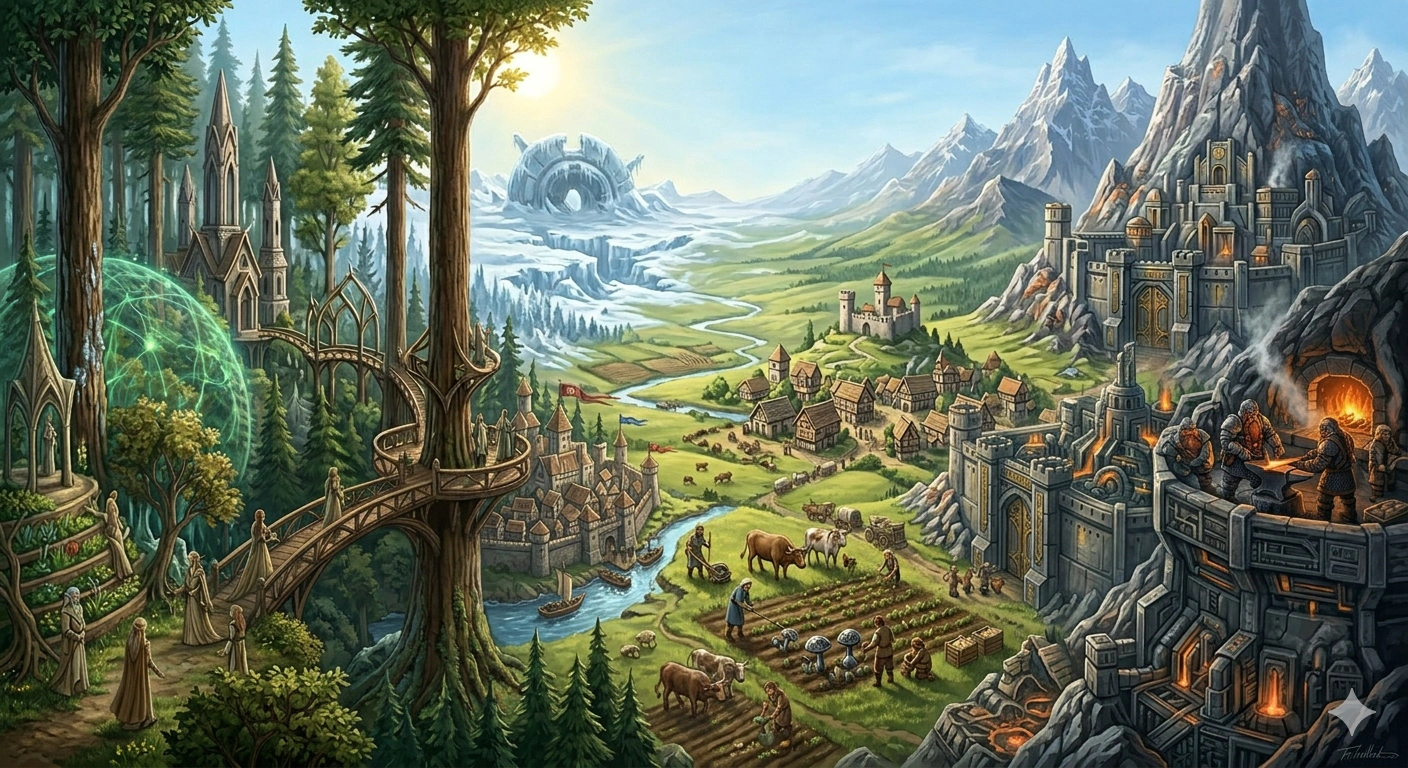
The Elves, both the High Elves of the misty Northwest and the Wood Elves of the ancient Northeast, did not build cities; they cultivated them. They viewed themselves not as masters of the forest, but as its consciousness.
Integrated Spires: Their architecture was grown rather than built, utilizing the ancient Iron-Oaks (the heavy-metal trees carried from the Ark) as skeletal support for living wood structures and high-altitude walkways.
The Magical Preserve: They created grand "Dominions" where the boundary between the forest and the settlement was invisible. Elven civilization became synonymous with ecological balance. They harnessed the fading energy ley-lines of the ship far below to create wards that masked their realms from hostile observation, dedicating their long lives to stewardship and preservation.
The Dwarven Ascendance: The Deep-Rock Citadels
While the Elves looked upward, the Dwarves forged deep into the iron-root peaks that had been thrust upward by the Ark’s original structural pylons.
The Materials of Legend: Their mining operations hit unique veins of material—alloys and rare elements that had accumulated on the ship during its trip through the cosmos. They discovered Mithral (strong as steel but light as a feather) and Adamantine (practically indestructible).
The Great Works: These materials, combined with geothermal vents that reached the ship’s dormant engines, fueled a dwarven renaissance. They crafted impenetrable fortress-cities like Iron-Garrison, connected by elaborate subterranean highways. Dwarven culture was defined by the quality of their craftsmanship; an object forged by their masters was considered a masterpiece of engineering.
The Human Hegemony: The Sword and Ploughshare
The Humans, occupying the vast, fertile prairies, Plains, and river valleys, experienced an explosive population boom. Their civilization was defined by rapid growth, agricultural dominance, and political fracturing.
The Rise of the Kingdoms: They tilled the land on a industrial scale, establishing vast medieval-style farm communities. In areas near the edges, they relied on hunting to manage the wild monsters that occasionally strayed. Unlike the unified, reclusive Elves or the hierarchical Dwarves, the Humans immediately began forming squabbling baronies, trading principalities, and expansive High Kingdoms.
The Nations of Etta: These human nations, built of stone and timber, became the true drivers of surface politics. They were aggressive, innovative, and constantly pushing against the borders of their neighbors, leading to the construction of massive fortified castles to protect their newly claimed nations and trade routes.
This divergence in civilization created a new, complex tapestry across Etta. While The 1st Age"Covenant of the North" kept a tenuous peace, the rapid expansion of the human kingdoms, fueled by the materials provided by dwarven smiths, began to put strain on the ancient borders of the Elven woods. The map of Etta was being redrawn not by geography, but by national intent.